Going through a lot? Remember this

There was this time that I came across a beautiful narration. I’m not quite sure if this actually happened somewhere on this Earth but the lesson it presents is truly valuable. Let’s see what it’s all about.

Artists were recruited for a competition in which they were required to portray in their painting an emotion that resonates with the judges on a particular topic.

After exploring various topics and having several of these talented artists eliminated, it was now time for the grand finale. Two of the artists were now left who would battle it out against each other. The topic the judges chose for this final round of the competition was peace. “Paint something to portray peace”, they unanimously instructed.

The artists immediately got busy, pouring hours of their creativity into what was to be their final painting.

When they were done and confident about what they had painted, they submitted their paintings for evaluation.

The judges took turns to inspect their work. Amazingly, two contrasting paintings were observed. Contrasting in the sense that whereas one immediately gave an impression of serenity and quietness, the other did the exact opposite- it portrayed terror.

The former was a painting of a quiet park that was beautifully adorned with trees with a warm and comfortable bench facing the sunset. The latter was a painting of a raging storm that looked vicious enough to destroy anything in its path.

This was a very easy decision to make. Without much thought, the judges were ready to come out with their verdict when one of them realized something about the painting of the raging storm. “Wait… look at this? there’s something there”.

Unbeknownst to them, in the midst of the storm, there was a rock that housed what looked like a lamb. The lamb looked so peaceful and totally oblivious of whatever storm was around it. The rock shielded it from the raging storm. At this realization, the tables turned and the award went to the painter of the raging storm.

What does this narration tell us about peace? Quite a lot. The first I can tell is that peace isn’t just the absence of chaos. It is really about finding a haven to abide in when you’re surrounded by the chaos.

Time and again, the Lord is referred to as our refuge. He is our haven that we can confidently flee to in the midst of the chaos. Jesus sought to teach His disciples this truth firsthand as they were caught by a great tempest in the sea.

Jesus by then was calmly sleeping even in the midst of that tempest (something His disciples didn’t take lightly). They promptly woke Him up and rebuked Him saying “don’t you care that we perish?”.

Jesus, on the other hand, rebuked them for their little faith. They couldn’t believe that He, Jesus, was their peace in the midst of the storm. Neither could they believe the promise in Isaiah that says that the Lord will be with them through the water so that it shall not overflow over them.


When you pass through the waters, I will be with you; and when you pass through the rivers, they will not sweep over you. When you walk through the fire, you will not be burned; the flames will not set you ablaze. – Isaiah 43:2


Let’s take a cue from this, dear friend. The raging storms are still as real today as they were during those times. Today we can talk about so much anxiety, depression, diseases, poverty and its surrounding uncertainties.

We might be tempted to think that the only way we can survive is when all these storms are stilled and everything becomes calm and comfortable.

But what if right in the midst of all that chaos, you can have and experience a peace which surpasses understanding? This is a reality, dear friend. Peace is what we experience when we abide in our refuge and place our trust in Him. Jesus is our refuge and in Him, no storm is strong enough to upset us out of the warmth of His care.
Strength Through Weakness

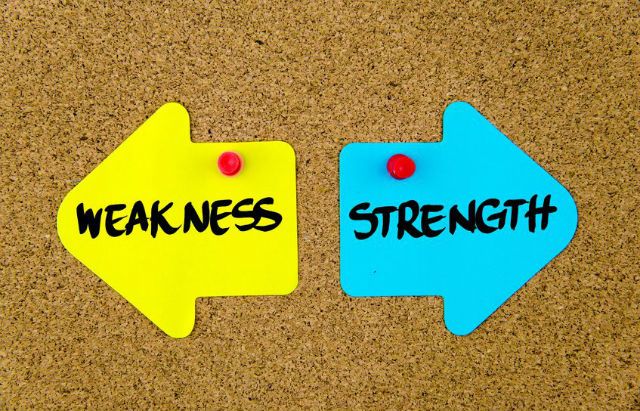
“Maximize your strength and minimize your weakness.” This has become the all-too-familiar adage when it comes to weaknesses and strengths. The simple reason for this mindset is that our strengths make us feel superior and good about ourselves. Weaknesses, on the other hand, seem to steal our boast and hurt our pride. So why not sweep the latter under the carpet and portray the former to all and sundry?

From a young age, we are subtly trained to think this way. We are praised for what we do well and quietly discouraged from showing where we struggle. Over time, we begin to build identities around our strengths while hiding our weaknesses. We polish the parts of ourselves that attract admiration and conceal the ones that make us feel vulnerable. It becomes almost instinctive — showcase strength, conceal weakness.

Image is in public domain

We normally like to think about strength as something good and weakness as something bad, right? But what if there’s actually more to this? What if there’s some kind of dynamics to this issue that we are oblivious to? What if weaknesses are not obstacles to strength but pathways to it?

I like to start out on this “What if” path by asking two fundamental questions. Perhaps these questions might open us up to a different line of reasoning:

• In the absence of weaknesses, would we really have known what strengths are?

• In the absence of strengths, would we have known what weaknesses are?

These questions suggest something interesting — that strengths and weaknesses may not be opposites fighting against each other, but partners working together. Each exists to draw out the full essence of the other. Without one, the other loses its meaning.

I believe that the essence of the strength–weakness paradox is an issue of complementarity. Each exists to reveal and refine the other. In my own life, I don’t think I would have embraced writing as a strength if I didn’t have a weakness in connecting with people in social settings, especially when it came to speaking. While others thrived in conversations and public interactions, I often found myself retreating inward. But in that retreat, I discovered something unexpected — the written word became my voice.

What initially looked like a limitation became a pathway. Writing became the space where I could connect, express, and communicate deeply. My weakness didn’t hinder me; it guided me toward a strength I may never have discovered otherwise.

In my experience, weaknesses rarely cause as much damage as we anticipate. Often, the fear of weakness is more crippling than the weakness itself. And it’s not just my experience — the Apostle Paul, the great Apostle, had a similar encounter.

Paul complained bitterly about a thorn in his flesh. Although we are not entirely certain what that thorn was, one thing is clear — it represented a weakness he wished to be free from. He feared that this weakness might hinder his ministry or diminish his effectiveness. Naturally, he asked God to take it away.

But what followed must have surprised him.

Instead of removing the thorn, God assured him that his weakness wasn’t the end of him, but rather the starting point of something greater. God told him, “My grace is sufficient for you, for my strength is made perfect in weakness.” In other words, Paul’s weakness became the very platform through which divine strength was revealed.

Strength through weakness may sound too idealistic or even unrealistic to many, but it reflects a deeper reality of life. There can be no real strength without weakness. Weakness humbles us, grounds us, and opens us to growth. It removes the illusion of self-sufficiency and creates room for something greater to emerge.

When Paul understood this, there was a remarkable shift in his reasoning. The once complaining, “take-it-away” mindset transformed into a joyful and reconciliatory one. He went from resisting his weakness to embracing it. He even went as far as saying he would rejoice in his weaknesses, because through them, strength was made visible.

This perspective changes everything.

So the question remains — what are weaknesses? More specifically, what are your weaknesses? Are they things you are glad about, or things you actively try to hide and deny?

Perhaps the very things you are most uncomfortable with are not obstacles but invitations. Invitations to discover new strengths. Invitations to grow in unexpected ways. Invitations to experience strength that goes beyond your own.

Your next reserve of strength may not lie in polishing what you already do well, but in embracing what you once considered a limitation. Because sometimes, in our weakness, strength does not merely appear — it is made perfect, manifested in full bloom.

‘The Proof’ or ‘The Truth’

In all our endeavors, at every turn, we have people in our lives who continually insist on us proving ourselves.

“If you love me then…”, our beloved would say.
“If you are really that good then… “, our prospects would also say.
I could go on and on but I have a feeling that you already get the direction I’m headed. You can even come up with some of these “proof statements” from your own experiences.

It was no different with Jesus in His temptation after having fasted 40 days and nights in the wilderness. The tempter asked that He proved Himself to be the Son of God. That wasn’t difficult; Jesus could easily have done that. In fact, doing just this single proof exercise would not only have proved His Sonship but also satisfied His hunger. After all, He was only expected to change stones to bread.

But here comes the caveat in our proving experiences… the intent and character of the one requesting for proof. Jesus knew that the devil knew who He was. Not only that, the tempter had tried on numerous occasions to destroy Him even when He was a baby- helpless and innocent. Why then did he need a proof? Surely, Jesus knew that the one who wanted His destruction wouldn’t be the least interested in His survival so much as to want to see His hungered body nourished. From all perspectives, nothing good could ever come out of the devil wanting Jesus to prove Himself Son of God.

Temptation of Jesus (from christianity.com)

Oftentimes the seeking of proof is, in itself, the admission of doubt. And some doubts never go away no matter the number of times we present proof. I see doubts in two ways; good doubt and bad doubt. A good doubt needs only one proof to believe but a bad one never gets enough of proof. In fact, for such doubt, one proof only begets multitudes of doubts and that defeats the very intent of our presenting proof. Come on, who wants to present proof just to amplify doubts!

Discerning the intent of the proof seeker helps you know exactly what you’re dealing with- good doubt or bad doubt. In the instance of Jesus’ temptation, He had just been affirmed as the Beloved Son of God at His baptism and the tempter knew that. Again, I think that some proof seekers are only there to undermine who we really are. They try to find loopholes and create some loops on their own when they don’t find any.

Jesus had the testimony of the Father and that was enough for Him. He needed no further proof to establish His Sonship. Just one truth from the Father was enough.

These are the times where the blessedness of believing without seeing is so pronounced. It’s a quiet assurance, a peace and contentment with who the Creator made you to be. If the Creator made you beautiful, don’t waste your time trying to prove how beautiful you are; just be yourself because you are beautiful. You don’t need 999 hashtags or likes on social media to prove your beauty. There’ll always be doubters no matter how hard you try to prove yourself beautiful.

Be secure in your identity. Your identity isn’t something to prove, it’s something to hold fast to. It’s not something you place on the dissection table; it’s something you keep in your treasure purse. When you know and do this, life will be much more stable for you and you can confidently ease your way through its challenges.

A New Paradigm of Grief (Form to Formless)

So I went for a funeral today and I had one of the most insightful moments of my life. It isn’t anything new. I’ve heard it before in so many ways but not quite in the way I did today. Someone I knew had passed away in one of the most unexpected ways. Most of us were still in shock and found it difficult to accept the reality. It was a bitter pill to swallow and not even the numerous assurances of “he’s dead” could force that reality down our throats.

I saw the funeral as the ultimate convicting voice that could help me come to grips with reality. Unconsciously, there was also this side of me that really wanted to meet the demised fellow for the very last time and have what would be my last encounter with him before he’s swallowed up by the earth in a wooden casket. I could hardly wait for this moment. I stayed up all night, imagining how emotional the whole encounter would be.

And there it was…the day finally came and I came face to face with this fellow but I sensed nothing- absolutely nothing. That’s not to say that there weren’t trickles of sorrow over my soul at the sight of my demised friend, but it was nothing close to the emotional farewell I had imagined prior to that time. I left the room where the corpse was laid in disappointment and feeling a little sorrow.


A life for another life

A form for another form


As I sat through the burial service, fatalistic thoughts of “so is that all that’s left of him? A lifeless and emotionless body?” flew right over my head (my mind held on to pieces of that though). I was interrupted in my little mental showdown by the tributes that were being read. I tried paying close attention to them and out of nowhere, everything came alive to me. It felt like I was living out my imaginative encounter with my demised friend. I had finally found the missing ingredient! I had discovered the life that my demised friend’s lifelessness provided.

It was all in the memories of him. There was once a time where I had related with my friend, form and all, when he was alive. He was very jovial, opinionated, and sometimes a little irritating to me. But altogether, he was beautiful and a great friend to me. I could hug him and feel the warmth of his body and the stench of his breath sometimes. I could hear him laugh heartily and see him make faces while he laughed. Today, I can’t have any of that. That body…face, potbelly and narrow waist… I was so used to had turned lifeless and had become pretty much hostile to me- not giving the slightest thought about me.

But the only thing that could get me all emotional were memories of him. Right in the burial service, I remembered how that we had met for the very first time at an event and we had quickly jelled together working as a team. I smiled at that memory. I also remembered when he would dance around the room any time he felt happy. At that memory, I held back a laughter. All day long, I had streams of emotions ranging from happiness to grief as I recounted memories of my departed friend.

This experience to me was a big shift because I realized that my friend wasn’t the silent lifeless motionless body in the casket waiting to be lowered deep into the earth. He had actually passed from form to formless and was now restful and at home in my memories. All that was left of him were memories and I came home from the funeral that day cherishing every detail of memory about him. And strangely for days, I never felt his absence. To me, he was ever with me because of his memories. I found a way to keep my friend, although dead, alive.


The dead are not dead;
they live in the fresh memories we hold dear.
And though they be dead
and heavy as lead,
in our minds they walk and talk, and breath, and eat bread.


I had to reconcile with the fact that I may never relate with him physically but I also realized that I could always have an emotional attachment with him as I reminisced memories of him- and that was wonderful. So the pain is lessened and the loss is much more bearable because he isn’t dead and gone. He has just passed from form to formless and is still actively with me.

Design a site like this with WordPress.com
Get started